Actions to Reveal and Disclose the Invisible
in Contemporary Art from KP Brehmer to the
Present
This article was written in 2020 within the scope of Narmanlı Sanat’s ‘Yazıhane’ project with the support of Aica NL and the Consulate General of the Netherlands:
https://narmanlisanat.com/kp-brehmer-ifsa-etme-egilimleri/
The word “disclosure” is defined in the dictionary as “to reveal something secret, to reveal, to spread, to announce, to expose, to advertise”. I aim to convey this context, which can be found when sought (indirectly or directly) in every work of art that has a certain purpose and motive to serve the good, through KP Brehmer‘s art practice and to clarify its effects / boundaries.
One of the reasons I chose KP Brehmer for this purpose is that he advocates “an art production that interferes with reality“ — as stated in the exhibition text. Revealing any hidden truth, revealing an institution, person, or power structure re- codes what we define as “reality“.
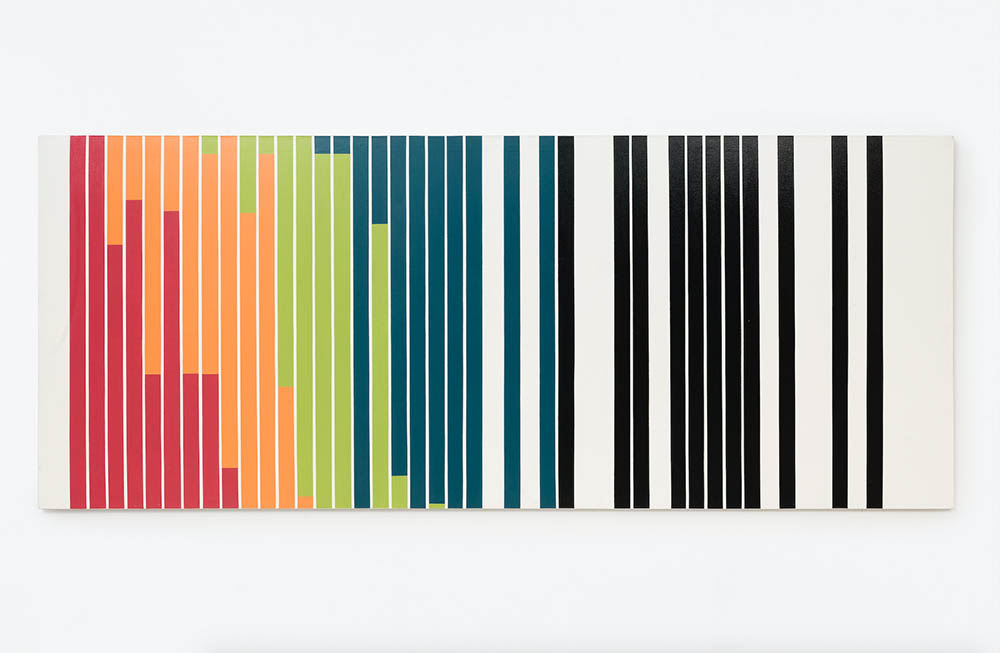
KP Brehmer, “Public Employees by Duty (Considering Income Levels)” 1976/77, Acrylic on canvas, 130 × 320 cm Arter Collection / Photograph: Roman Maerz
Among the tools that Brehmer developed on this recoding path, there are technological tools of the period such as thermography showing body temperature, data management, statistics and various visualizations. All of the maps, flags, scales and charts that exist in this visual graphic language present unusual data to the viewer, disguised as the image production tools that capitalist society uses to transform individuals into passive spectators and docile bodies.
Brehmer‘s works such as the “Spread of Meanings“ (1978) series, in which he explores the connotations of terms such as “Punishment“, “Police“, “Judgement“, and “The Spirit and Emotions of a Worker“ (1978-1980), reflect the state of encounter with the audience in a concrete form that can be called mathematical. He builds on direct roads and visu- alizes realities that no one wanted to talk about in 1970’s Germany.
Although the “visualization“ of the data here is the main tool of the disclosure method in the works, the works owe a large part of their meaning directly either to their own name or to their large-scale presentation.
Eve Kosofsky Sedgwick, who has studied queer theory, which is one of the most used areas of disclosure with both poli- tical and artistic purposes/contexts, mentions the practice of disclosure together with the problems of “demystifying“(1) and “denaturalizing“ and argues that it “leads to a paranoid epistemology“.
The anti-aesthetic stance, which we can think of as origina- ting from this “paranoid epistemology“ in the works, promises a very direct form of presentation that is far from taking us on an intellectual journey in the layers of meaning, as can often be seen in other works where the disclosure technique is used consciously/unconsciously.
This seems to be a common problem for many works that contain the context of disclosure. However, being “direct“ in making things visible may not be a problem for Brehmer and his works, who stated that “perceiving reality and guiding the individual‘s bond with it should be a priority“ without neglecting the sociopolitical environment of his age. Of course, making disclosure artistic (or instrumentalizing art for disclosure) can also create a context of memory and the idea of an archive that needs to be preserved, where an “immediacy“ beyond aesthetic concern is essential.
One of the goals of the “KP Brehmer: Big Picture” exhibition, which took place in Arter, is stated in the exhibition text as “to emphasize the actuality of the production of the artist, which problematizes and addresses the uninterrupted flow of images and information that defines the age of mass communication”.
At this point, if we continue to present (or problematize) one of the missions of the exhibition and continue to present (or problematize) the context of “Disclosure“ with the images produced by two contemporary artists who came after Brehmer and are still living, Anna Parisi and Heather Dewey- Hagborg may come to mind.
Black queer artist Parisi, who was born in Bahia, spent her childhood in Rio De Janeiro and now lives in New York, de- scribed her works as “opposing structural violence and op- pression; questions patriarchal, heteronormative, and racial hegemonies” and “feeds on questions that address traumatic violence against blacks, women, and historically oppressed bodies.” In an interview with Reset Fine Arts in February 2020.
Just as Brehmer was the subject of many social and economic problems in the Germany of the 70s he lived in(2) and 25 reflected these to his works, Parisi is an unprivileged person who is faced with the attacks of racism, homophobia and patriarchy in today‘s America.(3)
Parisi‘s installation ‚Raízes (Roots)‘ (2018), exhibited at La Galleria La Mama in New York as part of the Every Woman Biennial, is a work in which we can easily find the context of “revealing and disclosing“ through its visual form and materials. In her Installation, we encounter magnifying glasses positioned with an aesthetic resembling tree branches at different distances and angles from every direction.
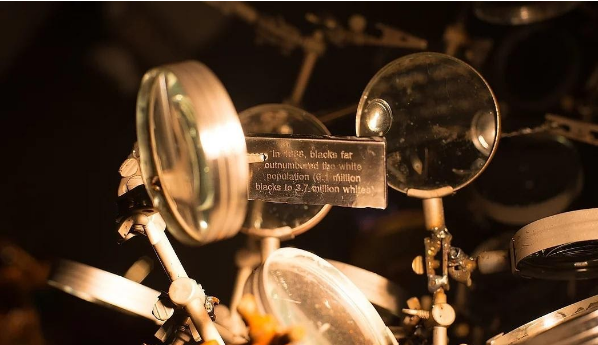
Anna Parisi, “Raízes” (“Roots”), 2018, iron clips, magnifying lenses, hand-engraved polished steel plates and rust.
The magnifying glass is a collective connotation that we can deal with in metaphorical or formal ways to make a hidden truth visible or to shed light on its details. In the work, multiple points in which all these magnifying glasses focus from different angles form multiple centers that direct our retinal movements within the placement.
In these centers, facts about colonialism and the historical process of oppressed peoples are written in a small size that cannot be seen with the naked eye; “In 1888, the number of blacks was subject to decline alongside the whites…”
We can determine that one of the methods used in disclosure prac- tices is “distance”. KP Brehmer frequently resorts to the method of creating a distance between the reality to be revealed and the audience in order to make social, cultural, political and economic processes more visible in his visual statistics, where he “records everyday life” and uses nationalist symbols/color schematics.
Brehmer provided us with a position where we could take a bird‘s- eye view of the sociopolitical situation of the geography he was dealing with, as if showing the “big picture” of social reality. In Parisi‘s “Raizes”, this distance moves in the opposite direction — without creating more or less “directness” — the big picture is transferred to the details, the bird‘s eye position is transferred to a face-to-face communication between reality and the viewer. Thus, the state of pointing to the truth through magnifying glasses (and the flow/control these magnifiers provide on our eye movements) has been created.
Heather Dewey-Hagborg is one of those we can trace in the artistic/scientific practice of the context of disclosure. She is an artist and biohacker who treats art as a field of research and technological criticism.
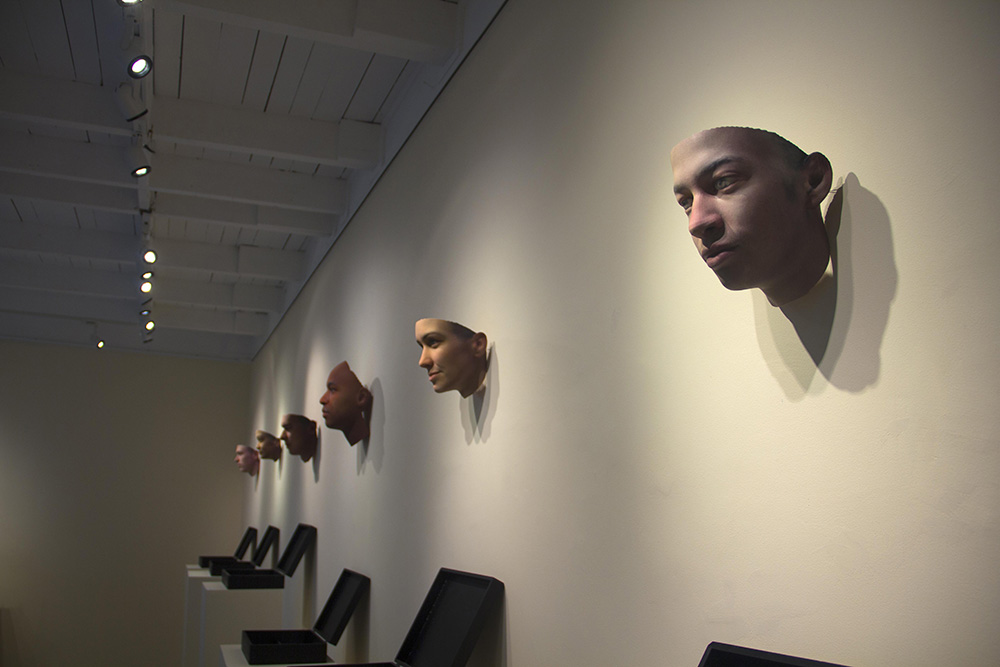
Heather Dewey-Hagborg, “Stranger Visions” September 2014, Saint-Gaudens National Historic Site
The project “Stranger Visions” (2012-13) includes portrait sculptures made with DNA material extracted from the ana- lyzes of genetic material (cigarette butts, chewed gum) col- lected from the public domain, records and photographs do- cumenting this DNA remnant itself, its location and history.
Archiving the story of the DNA material in a black box, as well as the copies obtained by DNA scanning, once again reinforces the dominance of the memory theme — as a for- ced aesthetic gesture — in the method of revealing, as in other works on disclosure.
She reflects the high technology of the period to her art prac- tice, making portraits public and using various faces, which are private images, to open the door to social and political discussions without the permission of their owners. Here, the type of disclosure, where we can sense the power of technology, pierces the limits of “directness“ and stands at a more “wild“ but still acceptable point. This confirms that Hagborg‘s practice -as the artist intended-is “a field of technological criticism“.
As a result, many forms of artistic disclosure have the mis- sion of bringing the individual closer to the social and purifying/awakening the reality of the audience from the lies/ hyper-reality created by mass manipulations through the identity of the artist or the realities they witness.
Diren Demir
(1) Demistification is a method of mass manipulation and management tools to standardize life. In a political sense, it can be read as the loss of the glory of a tyrant who rules over his people. But when this is applied to a work of art, the emotional process that the work aims to create is disrupted. So, should the “success“ of a work depend on the mysticism on which the work is based and the secret domination it establishes over the audience?
(2) Brehmer touched on class discrimination a lot in his work. Since he was a part of the people who coincided with the economic collapse during the 1973 Oil Crisis, which also affected Western Europe, he both experienced and observed this process, and in this context, the analysis of the economic collapse is reflected in his work.
(3) When we talk about the method of disclosure, which is originally a political tool, if we consider that disclosure on an individual scale is used by the subjects to ensure their own safety and that an “artisticized“ disclosure is a secondary priority besides the health of individuals, the subject Anna Parisi deals with art is the one she struggles with.
 Diren Demir