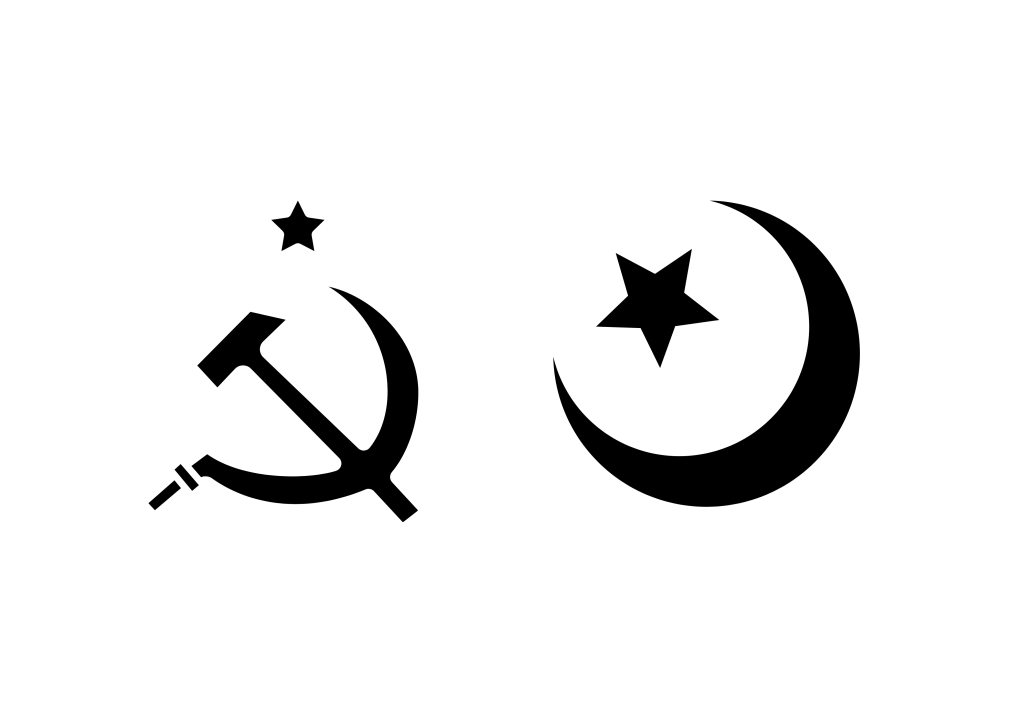
Marxo-Islamic Antizionism: An Ideological Convergence
Written by Diren Demir
01.06.2024
In this complex age and political unrest, many things have to be re-defined or new definitions have to be produced in order to find some solutions, clarity and understand the situation we are in. Here is one of them, a new description written by me, based on my observations, it is “Marxo-Islamic Antizionism”.
This necessary definition, Marxo-Islamic Antizionism (MIA) represents a confluence of Marxist and Islamist ideologies, united in their opposition to Zionism and the state of Israel. This article explores the historical and political roots of this ideological synthesis, its role in the policies of regimes like Iran, and its broader implications for radical Islamism and Western civilization.
Marxism and Islamism, though ideologically distinct, have historically found common ground in their critique of Western imperialism and capitalism. Marxism, rooted in the critique of capitalist structures and class struggles, and Islamism, focusing on the establishment of a political system based on Islamic principles, have both opposed Western hegemony. This commonality has paved the way for an ideological convergence, particularly in the context of anti-Zionism.
Anti-Zionism, the opposition to the establishment and existence of the state of Israel, has been a unifying factor. For Marxists, Israel is often viewed as an outpost of Western imperialism and capitalism in the Middle East. For Islamists, Israel is seen as a violation of Islamic land and a symbol of Western encroachment. This shared opposition has fostered a synthesis of Marxist and Islamist ideologies, culminating in Marxo-Islamic Antizionism.
The Islamic Republic of Iran provides a pertinent example of how anti-Zionism has been utilized to consolidate power and spread ideological influence. Since the 1979 Islamic Revolution, Iran’s regime has positioned itself as a staunch opponent of Israel. Anti-Zionism serves multiple functions for the Iranian regime: it legitimizes its rule domestically, rallies support among Muslims globally, and positions Iran as a leader in the Islamic world.
Iran’s anti-Zionist stance is not merely rhetorical; it translates into support for groups like Hezbollah and Hamas, which are committed to the destruction of Israel. This support extends beyond financial and military aid; it includes the propagation of an ideological framework that combines elements of Marxism and Islamism. By promoting Marxo-Islamic Antizionism, Iran seeks to unify disparate groups under a common cause, thereby extending its influence and countering Western and Israeli presence in the region.
This ideological synthesis provides us with a framework that resonates with marginalized (and so-called progressive) communities in the West, particularly those who view Western governments as oppressive and colonial. That’s of course not quite wrong, BUT: by framing their struggles within a broader narrative of anti-imperialism and anti-Zionism, radical Islamist groups can attract recruits and sympathizers from Western countries.
This exportation is facilitated by “Westernphobia,” where segments of Western citizens, influenced by a sense of white-colonial guilt, become critical of their own governments and societies. This critical stance often includes a rejection of Western foreign policies, particularly those perceived as supporting Israel. Western policies that support militarism, war and colonialism by hiding behind the liberal values of an equal society (which is a great form of “washing”) can justify the reaction against them. But, radical Islamist groups exploit this sentiment, framing their cause as a fight against Western imperialism and Zionist aggression, thereby gaining support among disillusioned Western citizens. The result is that jihadism is advertised, presented, promoted and bought as a decolonialist practice.
The combination of Marxo-Islamic Antizionism and Westernphobia creates a fertile ground for radicalization, undermines social cohesion, and complicates counter-terrorism efforts. The ideological convergence blurs the lines between legitimate criticism of Israeli policies and anti-Semitic rhetoric, making it difficult to address the underlying issues without exacerbating tensions.
Marxo-Islamic Antizionism thrives on the perpetuation of conflict and confusion. Radicalization and polarization create a continuous state of crisis and confrontation, which is essential for maintaining the ideological fervor and mobilizing support. The existence of an “external enemy”, whether it is Israel or the broader Western world, helps to unify and sustain the movement. Global mass-radicalization that is generated in this process serves to marginalize moderate voices that advocate for dialogue and reconciliation. By creating a polarized environment, Marxo-Islamic Antizionism ensures that the only viable options are extreme positions, thereby solidifying its base and deterring dissent. This polarization also makes it difficult for moderates to find common ground, further entrenching divisions.
The hard-won human rights in the West were achieved through persistent struggle and demands by the people against entrenched power structures. The rising influence of Marxo-Islamic Antizionism presents a significant threat to Western societies. If left unchecked, this ideology could lead to a rollback of the rights and freedoms that have been painstakingly won over centuries.
White-Western-confidence in the permanence of these rights and the resilience of social structures often stems from a belief that these achievements are already secured. However, this confidence can be misplaced when it overlooks these potential threats. What a tragedy and what a great weakness that the Western-left, full of white western confidence (but also guilt), sees this as a delusional fear… Jihadism, masquerading as a form of progressivism, seems to be already infiltrating social and political structures.
Diren Demir
 Diren Demir